Guide
Viking vs Wolf: A Fair Look at Ranges, Ovens and Upkeep
If you are weighing Viking vs Wolf, the short answer is that both build serious professional-style cooking equipment, but the two companies are organized differently. Wolf makes cooking appliances and nothing else, leaving cold storage to its sister brand Sub-Zero, while Viking sells ranges, wall ovens and built-in refrigerators under one name. On its gas ranges Wolf publishes a 30,000 Btu bake burner for the larger ovens; Viking steers buyers toward its gas ovens for broiling and its electric convection ovens for baking on several racks at once. Which one suits you depends on how you cook, whether one badge across the whole kitchen matters, and how easily the appliance can be kept running for many years.
What each brand actually builds
The first difference is scope, and it shapes everything after it. Wolf is purely a cooking brand, covering ranges, rangetops, cooktops, wall ovens, steam and speed ovens and ventilation hoods. Matching cold storage comes from the partner line, Sub-Zero, and owners of both register and look up support through the same Sub-Zero Group tools. Viking covers both halves of the kitchen on its own, selling cooking appliances alongside built-in and fully integrated refrigerators, freezers and wine cellars. Neither approach is wrong. A family remodeling in Ladera Ranch who wants every appliance from one company, with one style of handle and knob, may lean toward Viking. Someone who already owns a Sub-Zero and wants a cooking partner from the same family will find Wolf the natural match, since the two lines are designed to sit side by side.
Gas ranges: burners, ovens and broilers
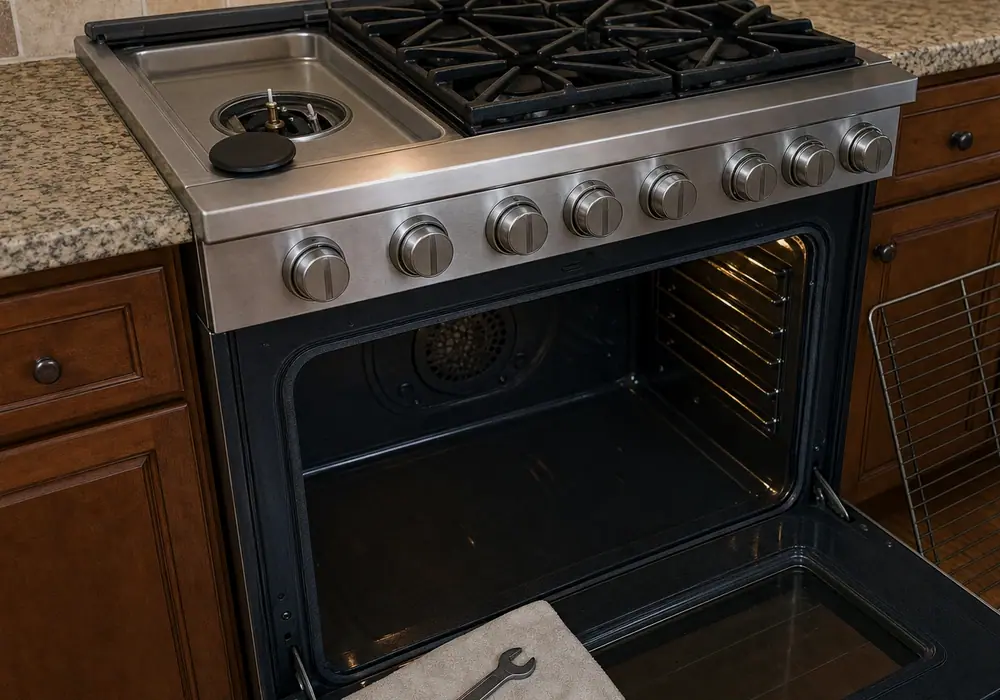
On the range itself, Wolf is unusually open about its numbers. In the 30-inch and 36-inch ovens of its GR gas ranges, baking runs on a 30,000 Btu burner and broiling on a separate 18,000 Btu one, whereas the compact 18-inch oven relies on a single 18,000 Btu burner for baking with no broil burner, and propane models lose nothing against their natural gas twins. Wolf's surface burners use a dual-stacked sealed design intended to give a strong flame and a very gentle simmer from the same burner. Viking frames the choice by oven type rather than burner figures: it describes its gas ovens, fitted with the Gourmet-Glo infrared broiler, as the better pick for broiling and single-rack baking, and its electric ovens, built around the patented Vari-Speed Dual Flow convection system, as the stronger choice when several racks go in at once. So a cook who sears steaks and broils fish most nights may be happy with either brand's gas oven, while a baker turning out trays of cookies for the holidays should look closely at an electric convection oven, whichever name is on the door.
Wall ovens: Wolf M and E Series against Viking 5 and 7 Series
Wall ovens are where model letters start to matter, and Wolf's decode quickly. The opening letters name the oven type, so SO means one cavity, DO means two and CSO marks a convection steam unit. After that, a letter pair reveals line and design: an oven from the M line reads TM, PM or CM depending on whether it wears Transitional, Professional or Contemporary trim, and one from the E line reads TE or PE for Transitional or Professional. Ten modes are listed for M Series ovens, namely Bake, Roast, Broil, Convection Roast, Convection, Gourmet, Proof, Stone, Dehydrate and Warm, although Stone and Dehydrate only work with the matching accessories. Viking's built-in electric wall ovens come as the 5 Series and 7 Series. Most of them self-clean in about 3 1/2 hours and then need another 30 minutes to cool before the door latch releases, yet two exceptions skip self-cleaning entirely: the VSOF7301, a single oven with French doors, and the top compartment of the VDOF7301 double model. If you dread scrubbing an oven by hand, that detail deserves a place on your shopping list before you fall for the look of those doors.
- Wolf single, double and steam ovens: SO, DO and CSO
- Wolf M Series styles: TM, PM and CM
- Wolf E Series styles: TE and PE
- Viking French Door ovens without self-clean: VSOF7301 and the top oven of VDOF7301
Refrigeration changes the comparison
Since the Wolf name never appears on cold storage, a fair comparison on that side of the kitchen sets Viking against Sub-Zero instead. A 5 Series Viking built-in relies on one variable-speed DC compressor paired with ProChill; step up to the 7 Series and each compartment gets a compressor of its own, so the two sides cool independently, and Viking says both lines stay within 1 degree of the setting. The documentation groups built-in models by their opening letters: a bottom-freezer starts VCBB, a side-by-side VCSB, a refrigerator-only column VCRB and a freezer-only column VCFB, and the custom panel equivalents swap in FDBB, FDSB, FDRB and FDFB. For fully hidden cabinetry there is the VEIL Integrated line, whose Double Pivot Hinge allows an installation with as little as a 1/8 inch reveal. In short, Viking can supply the cooking and the cold storage together, while a homeowner set on a Wolf range would pair it with Sub-Zero for refrigeration.
Where Thermador fits in a three-way choice
Plenty of shoppers put Thermador on the same list, and it belongs there. Thermador also builds professional-style ranges, rangetops and wall ovens, and its cooktops are easy to spot by their star-shaped burners, whose extra points spread the flame across a wider area of the pan bottom. In practice the three brands overlap more than the showroom pitch suggests, since all three offer gas and dual fuel ranges as well as single and double wall ovens. The questions that settle the decision are smaller and more personal. Does the oven you like clean itself? How many racks do you normally bake on? Do the knobs sit where your hands expect them? Can a technician who knows the brand reach Coto de Caza or Monarch Beach without a long wait? Our Thermador repair page covers what we see on that brand if it is still in the running for you.
Faults owners call about on both brands
Reliability on either brand tends to come down to the same handful of parts rather than the badge on the front. The most common gas range complaint is a burner that clicks but will not light, or one that keeps clicking after the flame is going. Both usually trace back to something simple: a burner cap left crooked after cleaning, ports blocked by a boil-over, or moisture on the igniter or inside the knob switches. Wolf burners relight on their own if the flame goes out, so a damp or dirty igniter can make the clicking seem endless. Ovens that will not come up to temperature and doors that will not close flush are the other regular calls. In homes near the ocean in Dana Point, Capistrano Beach and San Clemente, salty air also speeds corrosion on exposed metal, so igniters and spark electrodes there can wear sooner than they would inland. A few checks are worth trying before you book a visit.
- Lift each burner cap, wipe the cap and base dry, and set it back so it sits flat and centered.
- Clear blocked burner ports with a straight pin or a dry brush, never a wooden toothpick that can snap off inside.
- If clicking will not stop after a spill, turn the burner off and give the area several hours to dry before trying again.
- For an oven that runs cold, read our page on an oven that is not heating before assuming a major part has failed.
Service, parts and the rating plate
Whichever brand you choose, the details a technician needs are printed on the appliance itself. Wolf calls its serial tag the rating plate in its diagrams, and it lists the model number, serial number and total amps, with the manufacture date shown on some models. On SO3050 and DO3050 wall ovens open the door and look along the lower left trim, in the bottom cavity if it is a double; on convection steam and speed ovens, look along the left side of the face frame at the front instead. Wolf owners can register online or through the Sub-Zero Group Owner's App, and a warranty visit calls for the model and serial from that plate together with the date it was installed and who sold it, so file the receipt alongside the manual. Viking owners should gather the same information, particularly on older units, because several fully integrated Viking columns, such as the VRI7240W and VFI7240W, are now listed as discontinued, and parts for retired models can take longer to track down. We work on both brands across Orange County, from Irvine down to Talega; the Wolf repair page explains what a visit for that brand involves.
Questions
Answers before you call
Which lasts longer, a Wolf or a Viking range?
Neither brand is clearly more reliable, because most repairs on both involve the same small parts: igniters, spark switches, door hinges, gaskets and oven sensors. How the appliance is installed, cleaned and used matters more than the badge, and a burner kept dry and properly capped gives far less trouble on either one. Dana Point Sub-Zero Repair Specialists, Orange County: (858) 923-5340.
How do Wolf M Series and E Series wall ovens differ?
An M Series oven is offered in three styles, Transitional, Professional and Contemporary, and lists ten cooking modes including Gourmet, Proof and Stone, while an E Series oven comes in Transitional and Professional only. The model number tells you which one you own: TM, PM or CM marks an M Series oven, and TE or PE marks an E Series. Say so when you call Dana Point Sub-Zero Repair Specialists on (858) 923-5340.
Why does my Wolf burner click but not light?
A Wolf burner that clicks without lighting usually has a crooked burner cap, ports clogged by a spill, or a damp igniter. Reseat the cap so it sits flat, dry the burner and let it air out, and confirm the gas shutoff behind the range is open. If it still sparks with no flame, the igniter or spark module needs a technician. Dana Point Sub-Zero Repair Specialists answers that on (858) 923-5340.
If it is already broken
Appliance down in Orange County?
Tell us the brand and what it is doing — we can usually name the likely repair before we arrive.